
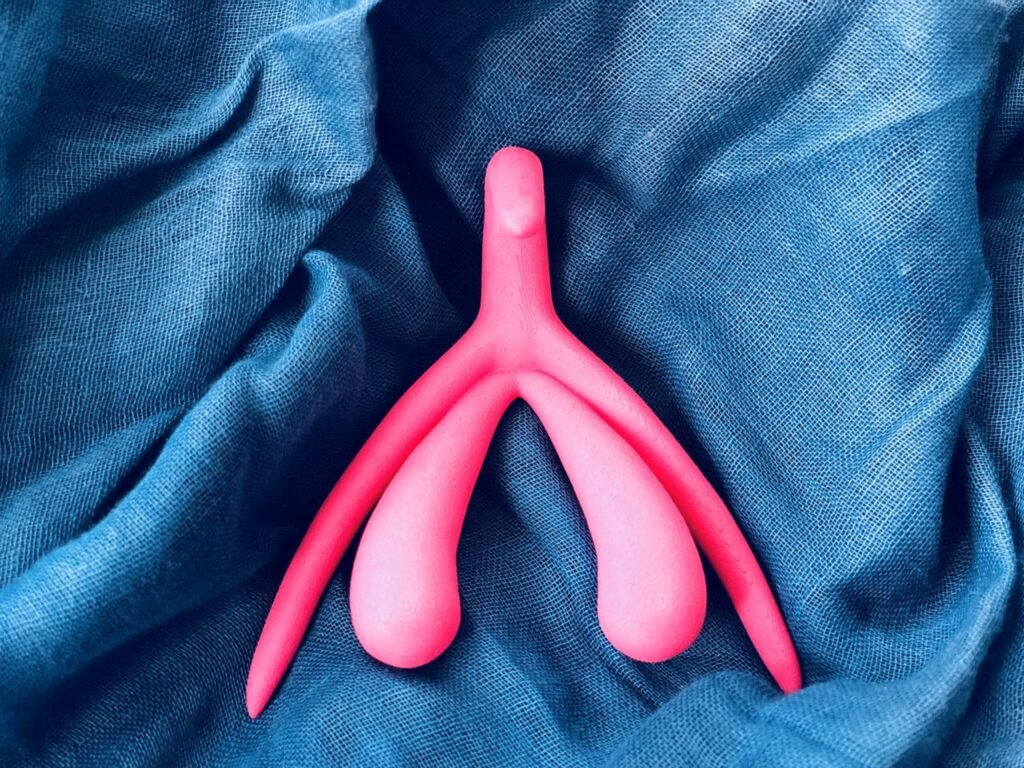
The clitoris is larger, more sensitive and more penis-like than you imagine!
Knowing your own clitoris (or your partner’s) is key to having good sex. But, even if you’ve Googled about the clitoris, you probably haven’t learned these unique facts.
In this article we will cover:
How sensitive is the clitoris?
There are an average of 10,281 nerve endings in the clitoris. For comparison, There are 17,000 nerve endings in the entire palm of your hand.
There are less than twice as many nerve endings in the clitoris, but the clitoris is a much smaller area. These nerves send signals to the brain, spine, and other parts of the body. As a result, the clitoris is an extremely sensitive and pleasurable area.
There are almost twice as many nerve endings in the clitoris as in the penis, but the clitoris is only one-eighth the size. The area of the clitoris most densely packed with nerve endings is the clitoral glans (that’s what we usually call the head of the clitoris).
People have been saying there are 8,000 nerve endings in the clitoris for years, but this statistic actually comes from a study on cows published in the ’70s (yikes!).
How big is the clitoris?
The clitoris grows significantly in size during arousal.
Do you know that a penis is much bigger when it is erect? The clitoris is also much larger, because it is erectile tissue.
What is erectile tissue?
“Erectile tissue is a tissue with numerous vascular spaces (also known as cavernous tissue) that can fill with blood. During arousal, this causes it to enlarge and/or harden” Barbara Carrellas, author of “Urban Tantra: sacred sex for the 21st century”says Bedbible.
Both the penis and the clitoris are erectile tissue. and as a result, they enlarge and harden when excited.
Where is the clitoris?
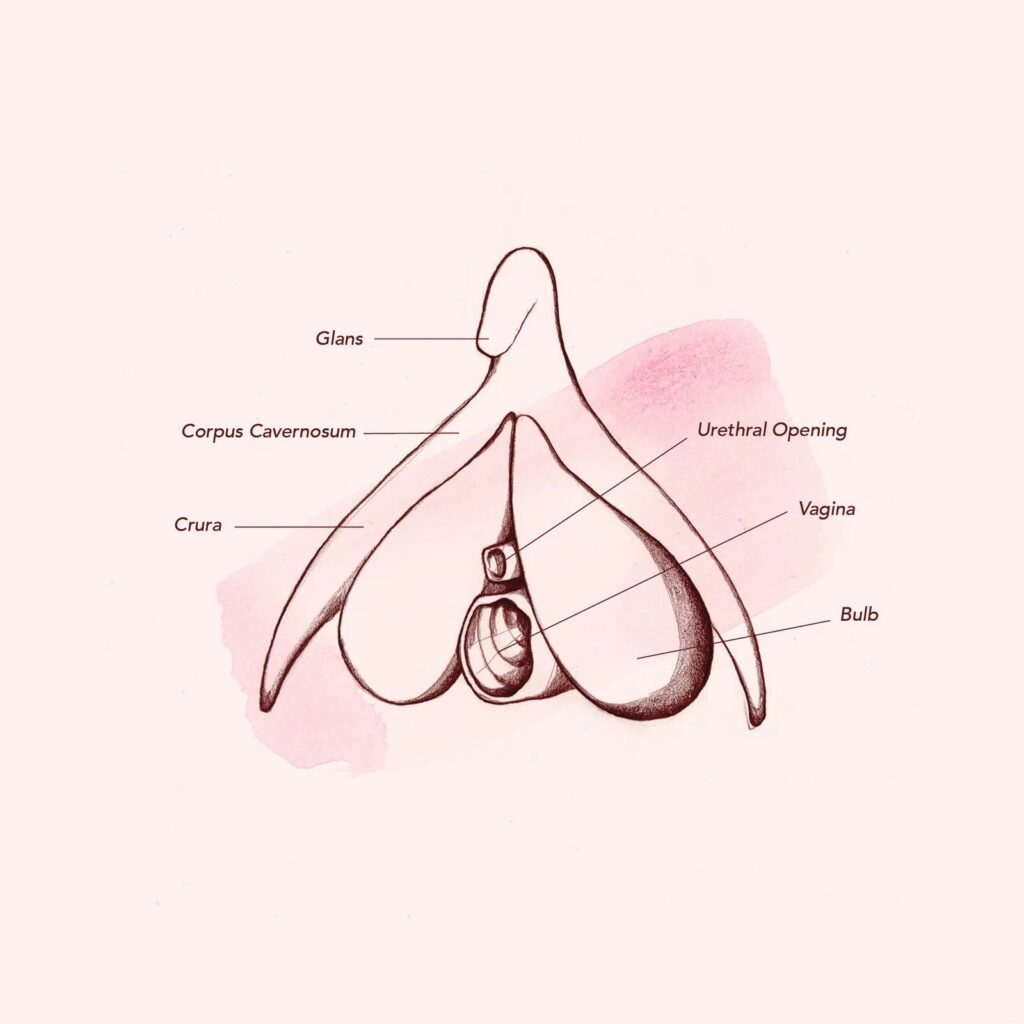
Most people think of the clitoris as a small point at the top of the vulva, but it is much larger. The small dot is the glans of the clitoris. The clitoral glans is the only visible part of the clitoris, but it is only one-fifth of the entire clitoris.
The rest of the clitoris is internal and the entire clitoris becomes erect during arousal, Carrellas says.
The clitoris has two bulbs that surround the vaginal opening and two “legs” or “cruras” that run internally under the outer lips.
How to stimulate the bulbs and pillars.
At the height of arousal, the bulbs are most pleasurable. Before even touching the clitoris, stimulate other places, such as the nipples, neck, belly, lips, ears or even the lower back.
Tease the clitoris by moving toward it and then backing away.
When the clitoris is erect, you can stimulate the bulbs and pillars by massaging the outer lips with your fingers. Using lube, trace the labia or apply gentle pressure and run your finger up and down the outer labia.
Vaginal penetration stimulates the clitoris.
For some people, vaginal penetration is pleasurable and this is typical because it stimulates the clitoris in different ways. One way that penetration stimulates the clitoris is through the bulbs.
The bulbs wrap around the vaginal opening, so “vaginal penetration stimulates the clitoral bulbs, which means vaginal orgasms are simply a different type of clitoral orgasm,” Carrellas says.
Penetration, for some people, stimulates the G-spot, which is another part of the internal clitoris, as well as the vaginal wall and urethra.
The penis and clitoris contain the same parts.
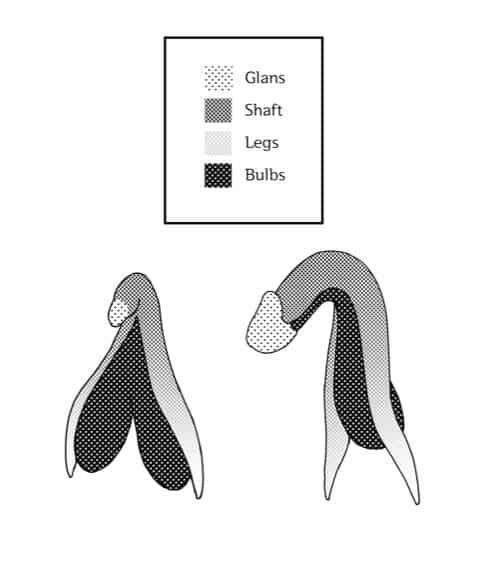
Many people think that the penis and the clitoris are different. They are very similar. They are made of the same parts, just arranged differently, which is scientifically known as homologous, according to sex researcher Dr. Emily Nagoski.
Below I will explain part by part the similarities between the penis and the clitoris.
How are the penis and clitoris formed?
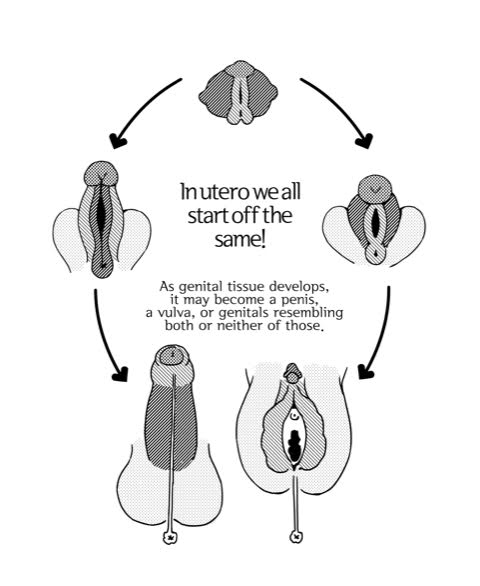
At six weeks, after a fertilized egg has implanted in the uterus, all fetuses have the same genital tissue, regardless of whether the fetus is male or female.
Then a wash of hormones is introduced and, if the fetus is male, the genital tissue begins to develop slightly differently than that of a female fetus.
A male fetus responds to hormonal washout and develops tissue into the penis, testicles, and scrotum. A female fetus develops this same genital tissue in the clitoris, ovaries and vaginal lips.
The key here is that all fetuses start with the same “hardware” or genital tissue and the hormones introduced to the fetus, as well as their chromosomes, determine the shape or body parts they develop into. This means that the clitoris and vulva are made up of the same parts as the penis.
Labia = Scrotum
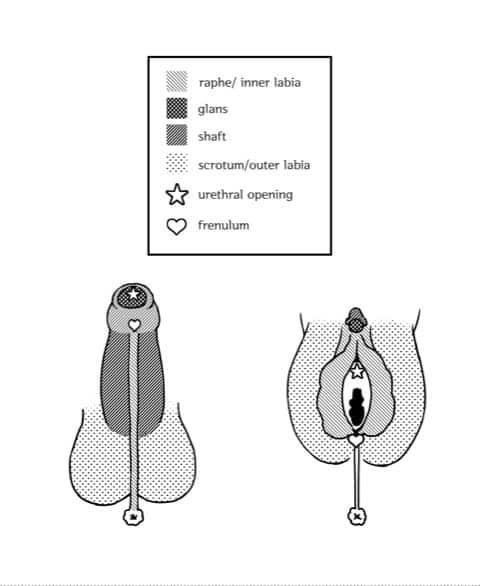
The labia (also known as the “outer lips” of the vulva) are made of the same genital tissue as the scrotum (also known as the “ballsack”).
If you look closely at the scrotum, you will notice a seam running up the center. It’s called the scrotal raphe, and this is where the scrotum would have divided into labia if the chemistry and chromosomes had been different, according to Nagoski.
Both the labia and the scrotum are soft, elastic tissues that grow coarse hair.
Functionally, both protect vital organs. The scrotum protects the testicles (where sperm are created) and the labia protect the vagina, which leads to the ovaries (among other important organs) where eggs are produced.
Glans of the clitoris = glans of the penis
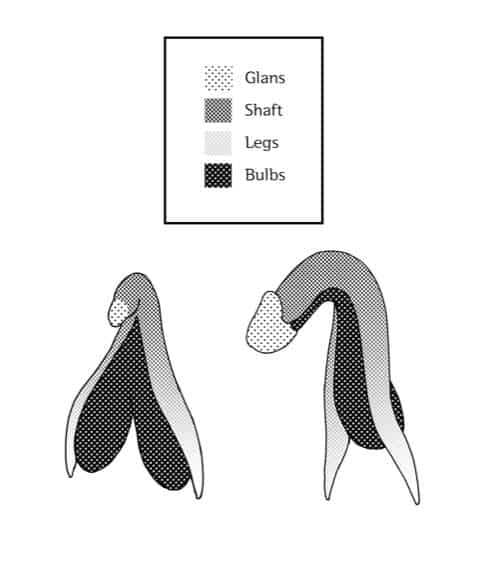
The small, outer part of the clitoris, known as the glans, developed from the same tissue as the glans, or what we often call the head of the penis.
Both areas are the most sensitive parts of the genitals.
You can see them represented in the diagram on the tip of the clitoris and the penis in white.
Clitoral bulbs = penis shaft
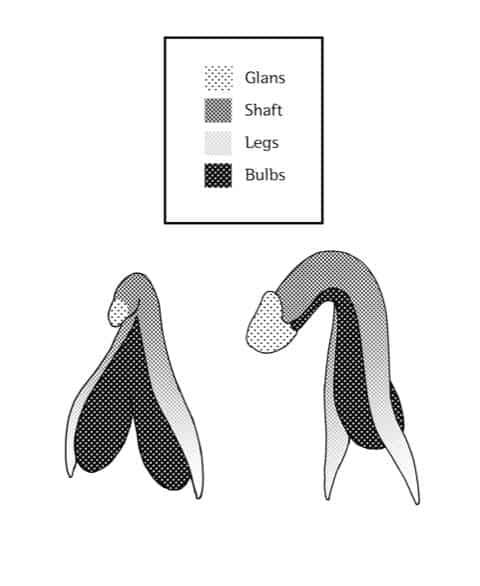
If you look at the diagram of the clitoris, you will notice that it has two large bulbs (the darker shaded area on the diagram). The scientific name of the bulbs is corpus cavernosum.
The body of the penis is also made up of the corpus cavernosum. As you can see in the diagram of the penis, the corpus cavernosum is located in the midsection of the shaft.
Clitoris legs = penis shaft
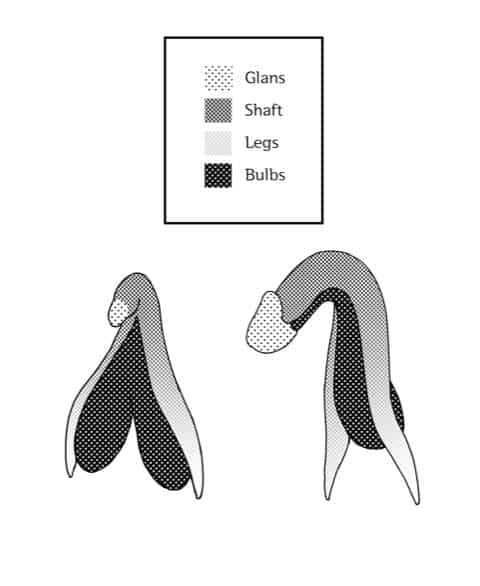
Another part of the clitoris is the “legs”, scientifically known as the “crura”. They are the lightly shaded part of the diagram that goes up and down either side of the clitoris, labeled legs.
The penis is also made of pillars. They also rise and fall on both sides of the penis shaft.
“All genitals are made of the same gelatin, poured into different molds” – Carrellas.
The only function of the clitoris is pleasure and it is very dense with nerve endings. But don’t forget that the clitoris is much more than the point at the top of the vulva.
You can stimulate other areas of the clitoris by massaging the labia or through the vaginal opening.
While people think that the penis and clitoris are very different, the penis and clitoris are the same parts, but arranged differently.
Both the clitoris and the penis become harder and, just as the penis becomes much more sensitive and pleasurable when erect, the clitoris does the same.