

Bringing up past mistakes during marital arguments destroys trust and intimacy. Find out why failure in the kitchen happens, what relationship experts say, and how to stay present to protect your bond with your spouse.
It starts with a simple, isolated disagreement. Maybe your spouse forgot to pick up an item from the grocery store, or maybe one of you left a pile of dirty dishes on the counter. The problem is minor, manageable and easy to solve in a few minutes.
Suddenly, the tone changes. A comment awakens a memory from three months ago. Then comes a reference to a family reunion two years ago. Before you know it, an argument over grocery items has turned into an exhaustive review of every mistake, failure, and disappointment in the history of your marriage.
In Ultimate intimacyWe hear from countless couples who fall into exactly this pattern. Psychologists and relationship researchers often refer to this habit as “kitchen sinking.” When you bring up all the past grievances, you throw everything, including the kitchen sink, into the conflict.
While it may seem like you’re providing the evidence needed to win an argument, bringing up the past actively destroys trust, creates emotional distance, and sabotages physical intimacy. If you want to cultivate a strong, connected, and emotionally secure marriage, it is essential to learn to leave the past where it belongs.

The hidden danger of kitchen subsidence
When a disagreement breaks out, your brain instinctively seeks self-defense. Bringing up past mistakes can seem like a powerful way to protect yourself, gain influence, or prove your point. However, diverting attention from the current problem creates serious long-term damage.
1. Takes ownership of the current problem
Every argument needs a clear boundary. When you focus solely on the current situation, you can identify what went wrong and work together to find a solution. Bringing up old grievances completely derails the conversation. The original problem is forgotten and replaced by a chaotic web of unrelated grievances that neither of them can resolve in one fell swoop.
2. Causes defensiveness and flooding
When a spouse is overwhelmed by a sudden list of historical wrongdoings, their nervous system goes into a fight, flight, or freeze response. Relationship experts note that physiological flooding occurs when a person becomes emotionally overwhelmed, raising their heart rate above one hundred beats per minute. In this state, logical thinking is turned off. Your spouse stops listening to your words and starts building emotional walls to protect themselves.

3. Point out that forgiveness was never real
If you previously discussed an issue, resolved it, and declared that you forgave your spouse, bringing it up again during a new discussion communicates a painful message: I never really forgave you and I’m saving this mistake to use against you later. True forgiveness requires giving up the right to use past mistakes as weapons.
What science and experts say
Decades of marriage research confirm that how couples handle conflict determines the longevity and satisfaction of their relationship.
Dr. John Gottman, a world-renowned relationship researcher who spent more than four decades studying thousands of couples, found that he could predict the future of a marriage with more than ninety percent accuracy based on how spouses communicate during conflict. Dr. Gottman identified four destructive communication patterns that predict divorce, naming them the Four Horsemen of the Apocalypse: criticism, contempt, defensiveness, and avoidance.
Bringing up the past almost always implies criticism and contempt. Instead of expressing a specific need about today, attack your spouse’s character over time. Dr. Gottman noted that stable, happy marriages maintain a specific ratio during conflict: at least five positive interactions for every negative interaction. When an argument turns into an avalanche of past failures, that crucial relationship between positive and negative plummets, taking the quality of the marriage with it.
Relationship experts also highlight that sixty-nine percent of marital conflicts are perpetual problems. These are recurring differences rooted in personality, values, or lifestyle preferences. Happy couples learn to manage these differences with patience and humor. Unhappy couples, on the other hand, relitigate the past over and over again, turning everyday disagreements into exhausting, repetitive battles.

Why spouses bring up the past
To break a bad habit, you must first understand why it exists. Spouses rarely bring up the past out of sheer malice. More often, it arises from unaddressed emotional pain.
- Unresolved pain: If an old wound was swept under the rug instead of properly addressed, forgiven, and healed, it remains active beneath the surface. The current argument acts as a trigger, releasing pent-up frustration.
- Feeling unheard: If a spouse feels like their partner never really understood how much an event hurt them, they will bring it up repeatedly in an attempt to finally gain validation and empathy.
- A desire for leverage: When one spouse is feeling vulnerable or losing ground in a current argument, bringing up past mistakes can seem like an easy way to tip the scales in your favor.
How to stay present and stop mentioning the past
Breaking away from old habits requires intentional practice, self-awareness, and teamwork. Here are practical strategies you and your spouse can implement today to keep your conflicts healthy and constructive.
1. Adopt the one problem at a time rule
Agree together that each argument should remain strictly tied to a single topic. If you’re discussing the schedule for next weekend, don’t bring up a missed event from last year. If your spouse accidentally wanders into past territory, gently return focus by saying: “I want to address that old problem with you, but first let’s finish solving this current problem.”
2. Practice soft starts
Dr. John Gottman discovered that ninety-six percent of arguments end in exactly the same tone in which they begin. If you start a conversation with harsh criticism or a recap of past mistakes, your spouse will instantly become defensive. Instead, use a soft start. Focus on your immediate feelings and express a positive need using I statements.
- Rather: “You always ignore my requests just like you did last month.”
- Attempt: “Today I feel overwhelmed and really need help cleaning the kitchen.”
3. Schedule separate conversations for unresolved wounds
If a past event keeps resurfacing in your mind, it means you have unhealed pain that needs dedicated attention. Don’t try to process deep historical wounds in the midst of a global disagreement. Set aside a moment of calm and quiet specifically to talk about that event, express your feelings, offer genuine apologies, and establish a clear path toward true healing and closure.
4. Take a break when you’re swamped
When you feel the need to tell your spouse a long list of past grievances, your emotional brain is taking over. Recognize the physical signs of frustration in your body. Calmly tell your spouse that you need a short break to calm down. Take twenty to thirty minutes to breathe, go for a walk, or listen to music. Return to the conversation only when you feel calm and present.
Protecting your physical and emotional privacy
After all, marriage is not a court. You are not a prosecutor trying to build a case and your spouse is not the defense. You are on the same team.
When you choose to stop bringing up the past, you create a safe environment where you can both be vulnerable, make mistakes, and grow together without fear. That emotional security is the precise foundation required for deep connection, genuine joy, and passionate physical intimacy.
Ultimate intimacy
What if an app could completely change your marriage, emotionally, physically, and intimately?

With almost 1 million downloads and almost perfect 5 star ratingtea Ultimate Intimacy App It is not just another marital tool, it is the The number one resource that excites couples around the world. Because? Because it works.

Created with therapists and marriage experts, this app helps couples rekindle passion, deepen emotional connection, and regain the spark in and out of the bedroom. And he has done the same with thousands like you.
Inside you will find:
- Exciting sex and intimacy games
- Truth or Dare: Bedroom Edition
- More than 150 tasty sex positions with detailed instructions
- Spicy Conversation Starters & Do you prefer
- intimate talk & personalized intimacy calendar
- Love Language Quizzesarticles, product recommendations and much more.
This isn’t just an app: it’s your personal intimacy coach, your playful bedroom companion, and your emotional reconnection tool all in one.
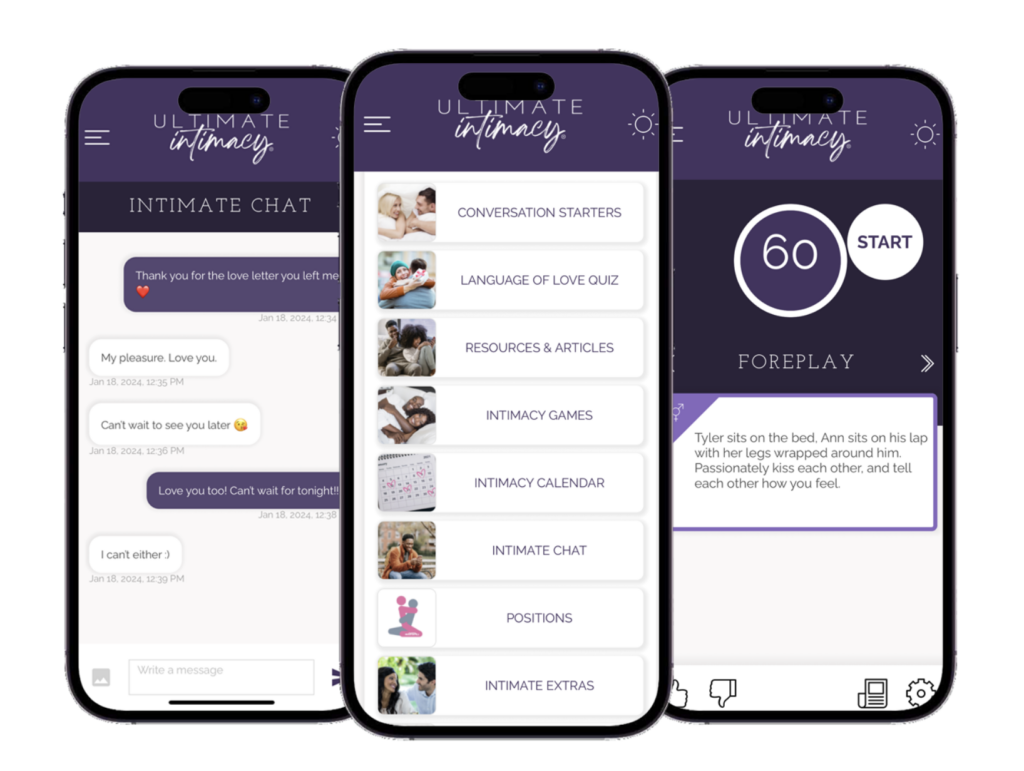
Don’t wait to rediscover each other. Download the Ultimate Intimacy App today, because your marriage deserves more than the average.
Download it for free today by clicking the image or the App Store buttons below!


Transform your intimacy with our Christian products!
We offer tons of great intimate products, decks of cards, games, lubricants, massage oils and much more to spice up and enhance the intimacy in your relationship. we are a “Christian” store AND offers FREE shipping in the US! Simply click on any of the images below to go to our store.

11